×

The Standard e-Paper
Kenya’s Boldest Voice
 The Standard Group Plc is a
multi-media organization with investments in media platforms spanning newspaper
print operations, television, radio broadcasting, digital and online services. The
Standard Group is recognized as a leading multi-media house in Kenya with a key
influence in matters of national and international interest.
The Standard Group Plc is a
multi-media organization with investments in media platforms spanning newspaper
print operations, television, radio broadcasting, digital and online services. The
Standard Group is recognized as a leading multi-media house in Kenya with a key
influence in matters of national and international interest.

Audio By Vocalize
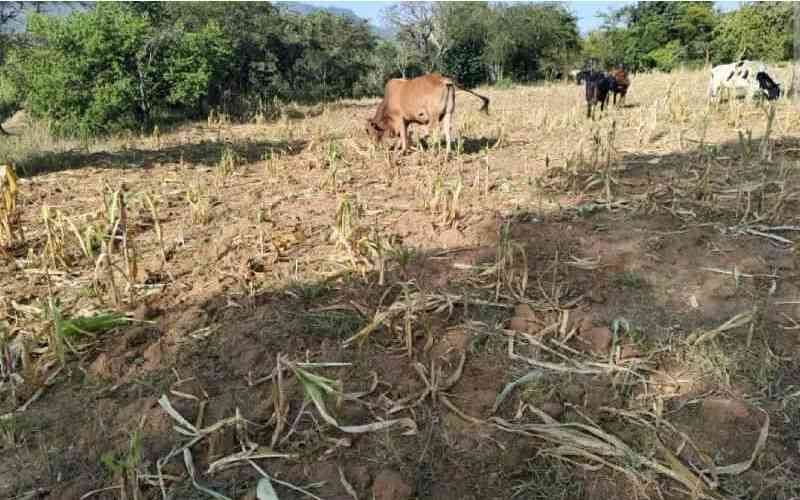
Withered maize crop in West Pokot after prolonged drought. [Irissheel Shanzu, Standard]
Prolonged drought in West Pokot County is worsening the humanitarian crisis, with authorities estimating that nearly 60,000 people are in urgent need of food assistance.
The dry spell has devastated livelihoods across the county, leaving farms barren, drying up water sources and threatening the survival of livestock, which many families depend on as their primary source of income.
Residents say the situation has worsened over the past several months as rainfall has remained far below normal.
In some of the hardest-hit areas, including Masol in Pokot Central, families are struggling to access food, while pastoralists have been forced to migrate with their animals to neighbouring Uganda in search of pasture and water.
Speaking while distributing camels to the residents, Sigor MP Peter Lochakapong said that the region has suffered widespread crop failure, raising fears of worsening hunger if the drought persists.
Lochakapong warned that livestock deaths could increase significantly should the dry conditions continue, further undermining household incomes and food security.
“As you can see in this area the way it has dried up and the animals are at risk of dying because of lack of water and also lack of grass,” he said.
The prolonged drought has also taken a toll on water availability, with many small dams and seasonal water sources drying up. This has forced residents to travel longer distances in search of water for domestic use and for their livestock, increasing the burden on already vulnerable households.
“Drought has come with full force and has overwhelmed the area,” said Samuel Kamal, a Masol elder.
As food supplies diminish, many families have become increasingly dependent on relief assistance. Community members say they are skipping meals and struggling to provide for their children, while concerns continue to grow over the impact of prolonged food shortages on health and nutrition.
“There is no maize in the area and we are crying to our government to come to our aid and give us food,” said Susan Kilee, a Masol resident.
Although efforts are being made to promote drought-resilient livelihoods, including the introduction of camels to some households, residents say immediate humanitarian support remains their greatest need as they contend with the effects of the prolonged dry spell.
The Kerio Valley Development Authority says it is promoting alternative livelihood options that are better suited to the harsh climatic conditions experienced in arid and semi-arid regions.
Stay informed. Subscribe to our newsletter
The authority notes that camels are more resilient to drought than many other livestock and can help households adapt to changing weather patterns.
“As you can see, this is an arid and semi-arid area where we have water and pasture scarcity and we want to introduce a change in the livelihood of the community, so we are accompanied by the community to hand over 100 resilient camels to fight the drought situation in the area,” said KVDA Acting Managing Director Moses Kipchumba.
Authorities say relief food distribution has already begun in the affected areas as efforts are intensified to cushion vulnerable families from worsening hunger.
Officials also say schools have received adequate supplies under the school feeding programme to ensure learners continue receiving meals and to minimize the risk of school dropouts.
“We won’t allow children to drop out of school, a mother to get problems of feeding their children,” Philip Mbuvi, DCC Pokot Central, affirmed.
“We will make sure that everyone gets enough food to continue with their daily lives,” he added.
Despite these interventions, residents maintain that the severity of the drought requires sustained humanitarian assistance and long-term investments in water infrastructure and climate-resilient livelihoods.
With the rains yet to return, communities fear the crisis could deepen further, threatening both lives and livelihoods across large parts of West Pokot.
Subscribe to our newsletter and stay updated on the latest developments and special offers!


 Prefer the Standard on Google









 join
join